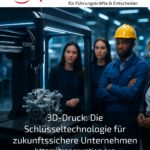
3D printing has established itself as one of the key technologies helping companies remain future-proof. It enables flexible production processes and opens up new possibilities in development and manufacturing. Through additive manufacturing, complex geometries can be realised that are difficult or impossible to achieve with conventional methods. Companies from numerous industries report significant advantages when strategically utilising 3D printing.
3D printing as an innovation driver for modern businesses
Many industrial companies primarily use 3D printing for prototype development. This can significantly speed up product development because designs can be quickly implemented and tested. For example, companies in the automotive sector use 3D printing to manufacture production-ready parts in small batches or to make individual modifications. It also simplifies the production of tools and complex components with optimised structures in mechanical engineering.
BEST PRACTICE with a client (Name withheld due to NDA agreement): A medium-sized engineering company improved its manufacturing processes using 3D printing methods. Tools and fixtures that were previously manufactured manually were created. Delivery times were reduced by over 50 percent, while costs fell due to lower material consumption.
Furthermore, users in the medical technology sector benefit from the capability to cost-effectively produce patient-specific implants or prosthetics with a precise fit. In this regard, 3D printing is not only faster but also enables new design approaches that were not previously feasible.
Flexible manufacturing and cost advantages through 3D printing
A significant advantage of 3D printing is the reduction of material waste. As the process is additive – meaning it works in layers – only the material that is actually needed for the component is used. This characteristic makes the process economically and ecologically attractive. Thus, small production runs are also economically feasible, which reduces or even makes traditional warehousing unnecessary.
In the aerospace industry, manufacturers benefit from 3D-printed parts that are lightweight yet exceptionally robust. This allows for the creation of innovative components that save weight, thereby reducing fuel consumption. Additionally, spare parts are produced as needed, which shortens supply chains and improves security of supply.
BEST PRACTICE with a client (name withheld due to NDA): A supplier from the aviation industry used 3D printing to produce complex brackets that were not achievable through conventional methods. This allowed for design improvements to be implemented and halved production time.
3D Printing in Industrial Everyday Life: Practical Examples from Various Sectors
In toolmaking, companies are increasingly using 3D printing to manufacture customised tools and aids quickly and cost-effectively. This makes production processes more reliable and flexible. For example, manufacturers of precision machines are implementing jigs that are precisely tailored to their needs.
In defence technology too, 3D printing supports the production of spare parts and specialised components, which significantly enhances supply chain security. This allows military facilities to adapt their equipment quickly and respond to unexpected demands.
In the shipbuilding industry, on the other hand, 3D printing facilitates the production of components in small series while maintaining high dimensional accuracy. This significantly lowers costs and optimises the maintenance of large ships.
Enablers and companions: Transruption coaching for 3D printing projects
Companies opting for 3D printing often face organisational and technical challenges. This is where transruptions-Coaching offers valuable support by guiding projects and providing impetus for successful implementation. Topics such as process integration, employee training, or selecting the appropriate technology are addressed individually.
BEST PRACTICE with a client (name withheld due to NDA agreement): A major industrial group utilised transruptions coaching to internally establish their own 3D printing service. Through targeted moderation and methodical advice, employees were able to quickly become productive and successfully implement innovative manufacturing approaches.
This is how companies benefit from comprehensive support that covers not only technical aspects but also considers cultural and strategic issues.
My analysis
3D printing is a key technology for the competitiveness of modern companies. It supports flexible, cost-efficient production and allows for individual solutions. The rapid adaptability of manufacturing processes strengthens innovative capacity. Furthermore, the additive process reduces material consumption and enables new product designs that are not possible with conventional methods. Support through professional consulting and coaching is often a crucial success factor for the sustainable integration of 3D printing in the operation.
Further links from the text above:
The pros and cons of 3D printing [1]
3D Printing in Industry – Söhner Shop [2]
3D printing for businesses: what's more worthwhile?
Sectors – 3D Printing for Industrial Applications [4]
10 reasons why you should use 3D printing [5]
For more information and if you have any questions, please contact Contact us or read more blog posts on the topic TRANSRUPTION here.






 Deutsch
  English (UK)