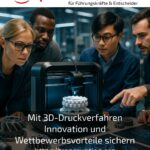
Increasing numbers of companies are discovering the potential of 3D printing processes to specifically drive innovation and secure sustainable competitive advantages. Especially in times of rapid technological developments, the use of 3D printing processes offers diverse opportunities to design products faster, more individually, and more resource-efficiently. Additive manufacturing, as 3D printing processes are also called, is revolutionising traditional manufacturing processes because it builds complex components and prototypes layer by layer and digitally controlled – often without high tooling costs or long lead times [1][2].
Customers from industry, medicine, education and design turn to us when they want to increase their competitiveness through 3D printing processes. They are looking for practical solutions to shorten development times, enable customisation and optimise costs. Our support through transruption coaching helps to identify potential, overcome hurdles and develop new business models.
Innovation Driver: 3D Printing Technologies - Applications and Practical Examples
3D printing processes are no longer a niche topic. They are used wherever flexibility, speed and individualisation are required. Industries such as mechanical engineering benefit from the ability to manufacture high-performance and lightweight components that would be difficult to produce using conventional methods [1]. In medicine, patient-specific implants, prostheses and anatomical models are created, making operations safer and improving training [1]. The automotive and aerospace industries also use 3D printing processes for prototypes, spare parts and even series production components.
In the field of education, 3D printing methods support practical learning, as pupils and students can immediately translate theoretical knowledge into real models. Artists and designers use the technology to develop unique sculptures, furniture, or fashion accessories that would be inconceivable with traditional methods [1]. The range of materials extends from plastics and metals to biocompatible substances – thus opening up ever-new fields of application.
3D printing methods are also gaining importance in the skilled trades and food industries. Bakeries are experimenting with personalised decorations, confectioners are designing chocolate artworks, and even meat-free alternatives are being built layer by layer. The technology makes it possible to cater to individual customer wishes while simultaneously conserving resources.
Advantages and challenges of 3D printing processes in everyday business
Efficiency, individualisation, and sustainability
3D printing methods offer numerous advantages over traditional manufacturing processes. They enable economic production even for small batch sizes and complex geometries, as expensive tooling is eliminated [2]. Companies can rapidly iterate prototypes, implement individual customer wishes and reduce stock levels, as components are printed on demand. The material selection is diverse: from standard plastics such as PLA or ABS, to high-performance polymers and metal alloys, much is possible [4][5].
Sustainability is another major topic. 3D printing processes often produce less waste because only the material that is actually needed is consumed. Energy consumption can also be lower, especially when components are printed directly in their final form [2]. Companies that focus on the circular economy use recyclable materials, thus optimising their environmental footprint.
Overcoming Challenges: From Technology Selection to Quality Management
Despite all the advantages, there are also hurdles. The selection of the appropriate 3D printing process is crucial, as each process delivers different materials, surface qualities, and mechanical properties [3][6]. Fused Deposition Modelling (FDM) is ideal for rapid prototypes and cost-effective models, while Stereolithography (SLA) and Selective Laser Sintering (SLS) enable the finest details and functional parts [4][5]. Metallic components often require special equipment such as Direct Metal Laser Sintering (DMLS) or Electron Beam Melting (EBM), which demand high investment [6].
Quality assurance is another critical point. Printed components must meet requirements, which necessitates regular testing and expertise. Many companies report that internal training and collaboration with experienced partners help to identify sources of error early and optimise processes.
Legal and regulatory aspects also play a role, particularly in regulated industries such as medical technology or aviation. Here, seamless documentation of production processes is essential. Transruption Coaching helps companies to keep all requirements in sight and to implement innovative solutions in a legally compliant manner.
3D Printing Methods in Practice: Three Best Practice Examples
The success of 3D printing processes is particularly evident in practice. Three examples from our consulting work illustrate how companies are breaking new ground with additive manufacturing.
BEST PRACTICE at the customer (name hidden due to NDA contract) A mechanical engineering company based in Swabia faced the challenge of manufacturing complex housing components for specialised machinery more quickly and cost-effectively. Previously, long lead times and high tooling costs had been the norm. By switching to 3D printing processes, development times were reduced by over 60%. The components were manufactured using both metal and plastic-based processes, which increased both flexibility and durability. The company now employs a hybrid strategy: standard parts are manufactured using traditional methods, whilst bespoke solutions are produced using additive manufacturing. This not only ensures competitiveness but also allows the company to respond individually to customer requirements.
BEST PRACTICE at the customer (name hidden due to NDA contract) A manufacturer of medical devices is using 3D printing processes to produce prosthetics and orthotics tailored precisely to each patient. Customisation was hardly possible and too expensive with conventional methods. Now, the required parts are generated directly from patient-specific scans and printed in biocompatible materials. Delivery times have been halved, and patient satisfaction has increased. At the same time, new sales channels have been opened up because the solution is scalable and can also be offered internationally.
BEST PRACTICE at the customer (name hidden due to NDA contract) A company from the education sector has integrated 3D printing processes into technical training. Students develop their own prototypes and implement them directly. The projects range from simple models to functioning machine components. Experience shows that practical relevance increases motivation and optimally prepares students for the demands of the job market. At the same time, innovative solutions are created that are often directly transferred to industrial applications.
Recommendations for action: How to successfully get started with 3D printing processes
Those who want to successfully use 3D printing processes should proceed systematically. Firstly, a thorough analysis of your own processes and products is worthwhile: Where are the bottlenecks, where is there potential for customisation or cost reduction? The selection of the appropriate process and material is crucial – experts and pilot projects can help minimise risks here.
Investments in know-how and training pay off because they prevent mistakes and ensure quality. Networking with other companies and involving suppliers can make the entry easier. Transruption coaching accompanies these steps and helps to make the right decisions.
Another tip: Start with manageable projects, gain experience, and then scale up gradually. This will allow you to remain flexible and respond to changing requirements. Involving employees from different departments promotes both acceptance and innovation.
My analysis
3D printing processes are more than an innovative manufacturing technique – they are a real gamechanger for companies that want to assert themselves on the market long-term. The advantages are obvious: shorter development times, higher flexibility, customisation and resource efficiency. At the same time, the technology and its integration into existing processes require expertise, the courage to change and a clear strategy.
Whether in mechanical engineering, medical technology, construction, or the creative industry – 3D printing processes open up new possibilities for strengthening competitiveness and bringing innovative products to market faster. Those who choose this path should not shy away from seeking support and actively shaping the change process.
3D printing processes are not a panacea, but a powerful tool for driving innovation and ensuring future viability. Companies that recognise and strategically leverage the opportunities will benefit in the long term – not only in technical, but also in economic and ecological terms.
Further links from the text above:
Areas of Application for 3D Printing | 3D-Model.com[1]
3D Printing | Wikipedia[2]
What types of 3D printers are there? | 3D-grenzenlos.de[3]
What are the types of 3D printing? | 3Dmensionals[4]
Guide to 3D Printing Materials | Formlabs[5]
Overview of Current 3D Printing Methods | 3Druck.com[6]
For more information and if you have any questions, please contact Contact us or read more blog posts on the topic TRANSRUPTION here.






 Deutsch
  English (UK)