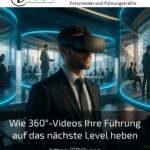
The modern world of work demands new approaches to leadership, communication, and motivation because traditional tools often reach their limits. 360° videos are much more than just a trend here – they open doors to innovative, inspiring formats that tangibly support leadership work and bring teams to a new level. Many companies are asking themselves how they can build trust with modern technologies, make processes understandable, and sustainably improve internal and external communication. This is precisely where 360° videos come in: they enable immersive experiences that equally engage employees, customers, and partners.
How 360° Videos Enhance Guidance and Collaboration
Leadership thrives on transparency, yet complex content is often difficult to convey. 360° videos offer clear visualisation, making processes, spaces, or products understandable for everyone. Such formats particularly clarify contexts in construction projects, product development, or training processes, because they make all perspectives experienceable simultaneously. Misunderstandings are reduced, and teams work together more efficiently because everyone has the same picture in mind [1].
Virtual tours can be used flexibly: In the logistics sector, they guide new employees through the warehouse and visualise processes live. In architecture, 360° videos enhance coordination between planning and execution, as details are visible from every direction. And in sales, customer trust increases because products are presented interactively – creating a real experience instead of a dry presentation[1].
It is important to actively involve the target audience. Leaders report that immersive videos increase motivation in the team because everyone can decide for themselves where to direct their gaze. Furthermore, follow-up questions can be clarified directly in the virtual space, saving time and fostering dialogue.
Diverse applications: From training to marketing
360° videos are not a one-way street but are encountered in many industries and use cases today. In the education sector, they invite interested parties to take virtual campus tours before they have even decided on a course of study. This creates proximity and simplifies the decision-making process because the environment can be experienced up close [1].
Immersive formats are also in demand in industry: large facilities can be explored safely before employees are on site. This reduces risks and shortens onboarding times. Companies from the event sector showcase trade fairs, concerts or company parties from all angles, so that remote guests can also be included[4].
In marketing, 360° videos score points with emotional stories surrounding products and services. This creates a realistic experience, particularly for vehicles, furniture, or technical devices, which can surpass traditional image galleries or brochures. Customers often report that they feel better informed after a virtual tour and make a purchasing decision more quickly [4].
BEST PRACTICE with one customer (name hidden due to NDA contract)
BEST PRACTICE with one customer (name hidden due to NDA contract) An international logistics provider specifically used 360° videos for internal training. New employees were able to understand processes from every angle and thus gained confidence in handling complex equipment. Onboarding time decreased significantly because questions were answered directly during the virtual tour. Managers reported greater independence within the team and increased identification with the company. The format was also used in customer interactions: potential business partners received an authentic insight into the processes, which sustainably strengthened trust. These examples demonstrate how 360° videos can advance collaboration and employer branding equally.
360° Videos in Practice: Tips for Successful Use
Those who want to make sensible use of 360° videos should observe a few basic rules. First, it's worth examining the added value precisely: not every topic is suitable for the immersive format. 360° videos unfold their full potential, especially when movement, spatiality, or the feeling of „being there“ are at the centre[3].
Quality is crucial – both in the recording and in post-processing. Professional cameras and clever image composition ensure a perfectly cohesive experience. Be sure to guide viewers through visual or auditory cues so they can orient themselves in the virtual space.
The platform plays an important role: 360° videos work equally well on smartphones, tablets, desktop computers, and VR headsets. Adapt the content to the respective target audience and regularly test how the format is received. Measure success using specific metrics such as viewing duration or interaction rate to continuously learn and optimise[3].
Another tip: Combine 360° videos with other formats, such as interactive elements or live chats. This creates a dialogue that strengthens the bond with your company. And remember that even a simple virtual tour can achieve a lot – a perfectionist approach isn't always necessary.
Why 360° Videos are Revolutionising Internal Communications
Internal communication particularly benefits from 360° videos and related technologies. Teams can collaborate independently of location as if they were in the same room – this saves travel time and promotes flexibility[2]. Virtual meetings become more lively because each participant can freely choose their viewing angle.
Managers use the format to make changes tangible. For example, restructurings or new processes can be clearly explained because everyone involved has the same basis. 360° videos are also a benefit for onboarding new colleagues: they convey company culture and the work environment authentically and ensure a quick start.
In product development, immersive videos support collaboration across locations. Engineers and designers communicate in real time and can immediately see how a prototype looks from different perspectives. This speeds up decision-making and enhances quality.
360° videos as part of a holistic digital strategy
360° videos are not an end in themselves, but rather a building block in a comprehensive digital strategy. They complement traditional communication channels and help to shape modern leadership. Many companies use them specifically for employer branding to position themselves as innovative employers[1].
Especially in times of home office and decentralised teams, immersive formats are a powerful tool for strengthening identity and cohesion. They are also suitable for customer events, virtual networking, or the presentation of sustainability projects – the application possibilities are virtually unlimited.
iROI-Coaching helps you with the conception, production, and analysis of 360° video projects. Together, we develop tailor-made solutions that advance your company – measurable, sustainable, and targeted. Get in touch if you're looking for inspiration for the next stage of your leadership work.
My analysis
360° videos are more than just a gimmick – they are a powerful tool for modern leadership and communication. They create transparency, promote understanding of complex content, and strengthen identification with the company. 360° videos particularly show their strength when it comes to supporting change, engaging teams, or making products emotionally tangible.
Practical examples from logistics, education, industry, and marketing demonstrate this: those who take innovative paths benefit from higher motivation, more efficient processes, and a positive external image. The right strategy and professional implementation are always key. 360° videos are a valuable companion on the way to the next level of leadership – and iROI Coaching supports you in unlocking your full potential.
Further links from the text above:
How 360° Production Will Revolutionise Your Leadership Work[1]
360-degree videos and virtual reality[2]
For more information and if you have any questions, please contact Contact us or read more blog posts on the topic internet Return on Investment - Marketing here.






 Deutsch
  English (UK)