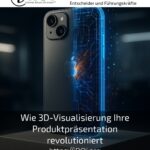
3D visualisation has proven to be an innovative tool that diversely supports and revolutionises product presentation. Through digital representation, products can be presented not only realistically but also interactively and flexibly. This allows companies from a wide range of industries to benefit from more efficient processes and increased customer loyalty.
Flexibility and variety of options through 3D visualisation
One of the greatest strengths of 3D visualisation lies in its ability to create product variations quickly and simply. For example, furniture manufacturers can showcase different designs, colours or materials using 3D models without having to produce physical samples. In the field of technical devices, various features and material options can be displayed digitally, which considerably simplifies presentations. The automotive industry also benefits from 3D visualisations, allowing for dynamic vehicle configuration. Customers can thus design and experience their desired vehicle virtually before placing an order.
BEST PRACTICE with one customer (name hidden due to NDA contract) This customer used 3D visualisation to digitally create numerous product variations and agree them with the end customers. This reduced development costs and allowed customer feedback to be integrated early on, significantly increasing satisfaction.
Cost savings and time savings with digital product presentation
3D visualisations significantly contribute to reducing time and costs in the product development process. Elaborate physical prototypes or photoshoots are eliminated. Instead, digital models can be efficiently adapted and optimised. This often shortens time-to-market. For example, a manufacturer of technical devices saves the cost of building expensive samples and demonstrates changes to customers directly on the 3D model. In the fashion industry too, virtual collections supported by 3D visualisation aid in planning new product lines without the need for physical samples.
BEST PRACTICE with one customer (name hidden due to NDA contract) In a modular furniture project, 3D visualisation enabled adjustments to be made in the shortest possible time without incurring additional production costs. This allowed the product range to be expanded with minimal effort and customer wishes to be responded to more quickly.
Interactive experiences strengthen customer loyalty
3D visualisation allows products to be not only shown realistically but also made interactive. Customers can rotate models, adopt different perspectives, or customise parts. This immersive experience is particularly beneficial for products requiring extensive explanation, such as in the medical technology or mechanical engineering sectors. Customers understand functions and advantages better, which builds trust. At trade fairs, interactive 3D visualisations demonstrably increase attention and visitor numbers. For instance, a manufacturer of conveyor systems reports that a 3D trade fair film attracted 30 percent more visitors to their stand. In e-commerce too, the option for individual product configuration increases the willingness to buy.
BEST PRACTICE with one customer (name hidden due to NDA contract) A medical technology manufacturer doubled the conversion rate on its website with an interactive 3D presentation, by clearly explaining and visualising complex features.
Technical possibilities and application examples of 3D visualisation
In addition to the benefits in product development, the quality of the presentation also plays a significant role. Modern 3D visualisations often achieve photorealistic quality, where light, materials and details appear deceptively real. Manufacturers of electronic products use this to showcase their high-tech devices with all their functional features without having to transport physical devices. An innovative example is the visualisation of machines with animated interior views that explain technical processes. In architecture, 3D environments are used to show furniture or outdoor facilities in their planned surroundings. This increases the understanding and imagination of potential customers.
BEST PRACTICE with one customer (name hidden due to NDA contract) For an outdoor rug, the company represented realistic 3D environments with minimalist outdoor spaces. This allowed customers to experience the rug in various contexts, which facilitated their purchasing decision.
Practical tips for using 3D visualisations
Companies should adopt 3D visualisation early on, ideally during the concept phase. This allows ideas to be communicated efficiently and customers or investors to be better involved. It is advisable to use digital product configurators that enable interaction. Animated 3D videos are suitable for trade fairs and online presentations to increase attention. Furthermore, consistent quality and scalability of 3D images should be ensured, so that they can be used in different ways – for example, for print, web or social media. Collaboration with experienced partners such as iROI-Coaching can specifically support projects related to 3D visualisation and secure their success.
My analysis
3D visualisation opens up new avenues for companies to present products in a flexible, cost-effective, and engaging way. It helps to reach customers more effectively through interactive and realistic representations and to communicate products convincingly early on. In many industries, the use of this technology is demonstrably increasing customer satisfaction and shortening development times. Companies that seize this opportunity can secure significant competitive advantages – especially when implementing projects with professional support such as iROI coaching.
Further links from the text above:
How 3D visualisation revolutionises your product presentation [1]
30 Great 3D Product Showcase & Visualisation Videos [2]
Warum 3D-Visualisierung ein Muss für Produkte ist [3]
3D product presentation: more attention at trade fairs [6]
How 3D Visualisations Revolutionise Product Presentation [13]
For more information and if you have any questions, please contact Contact us or read more blog posts on the topic internet Return on Investment - Marketing here.






 Deutsch
  English (UK)