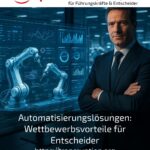
Automation solutions are becoming increasingly important for companies because they can create valuable competitive advantages for decision-makers. They enable an increase in efficiency, improve product quality, and promote flexible adaptation to changing market conditions. In doing so, automation solutions support companies in optimising resources and designing processes intelligently.
Automation solutions as the key to increasing efficiency
One of the key strengths of automation solutions lies in the significant reduction of manual intervention. Whereas in the past many routine tasks were carried out by employees, automated systems now perform these tasks precisely and quickly. This not only reduces errors, but also increases the speed and repeatability of processes. Manufacturing companies, for example, report that automated controls and sensors ensure consistently high product quality while simultaneously increasing machine operating times.
Even in service industries like e-commerce, advantages become apparent: the automation of order processing and warehouse management allows for faster order fulfilment and avoids errors in inventory management. This relieves employees and reduces costs through less waste.
BEST PRACTICE with a client (Name withheld due to NDA) A textile manufacturer was able to seamlessly integrate their production processes with e-commerce through automation with Zapier. This resulted in orders being automatically updated and customers being supplied faster, which improved customer satisfaction.
Flexibility and rapid adaptation through automation solutions
Decision-makers particularly value the scalability and adaptability of automation solutions. When market requirements change, processes can be quickly adapted with automated control systems and software solutions. This is important, for example, for suppliers in the automotive industry, who often have to reconfigure their production lines for new models and production volumes.
Logistics companies also benefit from automated route planning and inventory management systems that can react flexibly to demand fluctuations. This allows for shorter delivery times and lower operating costs.
BEST PRACTICE with a client (name withheld due to NDA agreement) An energy company used bespoke software solutions to automate its project management and increase efficiency in resource planning. Flexibility in planning enabled a rapid response to customer requirements.
Cost reduction and quality improvement through intelligent automation solutions
By implementing automated processes, companies can sustainably reduce their operating costs. Fewer manual tasks mean lower personnel costs, while precise processes simultaneously minimise material waste. In industry, this leads to less scrap and rework, for example.
Finance departments also benefit: automated accounting systems take over the creation of invoices, book payments and generate reports, which reduces errors and optimises resource utilisation.
BEST PRACTICE with a client (name withheld due to NDA) A consulting firm was able to reduce administrative workload and improve the experience for new colleagues by automating employee onboarding, which led to faster integration times.
Impulse for decision-making through data-driven automation solutions
Modern automation tools also offer valuable insights because they capture and analyse data in real-time. This allows managers to make informed decisions and improve production processes. In sales, automated tools can be used to consolidate customer data from various systems, enabling personalised marketing campaigns and fostering long-term customer loyalty.
In logistics too, the automation of routines helps to optimise resource consumption, for example of transport vehicles, while simultaneously increasing delivery reliability.
My analysis
Automation solutions offer decision-makers a variety of advantages: they increase efficiency, reduce costs, and improve the quality of products and services. At the same time, they make companies more flexible and adaptable in dynamic markets. Practical examples from various industries show how companies can strengthen their competitiveness and sustainably optimise operational processes through automation. The integration of data-driven systems enables progressive, future-oriented control.
Further links from the text above:
Advantages of automation: More efficiency for your company [1]
Automation projects and examples [2]
5 Advantages of automation solutions in the industry [3]
For more information and if you have any questions, please contact Contact us or read more blog posts on the topic TRANSRUPTION here.






 Deutsch
  English (UK)