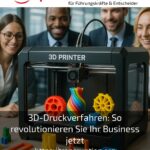
The integration of modern 3D printing processes opens up diverse opportunities for companies to make production processes more efficient and unlock innovation potential. Whether in manufacturing, medicine, or space exploration, additive manufacturing supports projects that overcome complex challenges and enable new product dimensions. In this article, you will learn how to make your business future-proof now with concrete examples and practical tips.
Diversity of 3D printing processes – Fundamentals and industrial applications
The world of 3D printing processes encompasses various technologies that differ depending on the material and application. The most common processes include Fused Deposition Modeling (FDM), Selective Laser Sintering (SLS), and Stereolithography (SLA). Each is suitable for different requirements, ranging from plastic prototypes to high-strength metal components.
In manufacturing, for example, custom tools and moulds are produced using 3D printing. This significantly reduces typical manufacturing costs and shortens development times. A company from Bremen uses this process to produce injection nozzles that are precisely tailored to process requirements, thereby optimising adhesive application in conveyor system construction [2]. Such applications demonstrate how 3D printers can contribute to solving specific challenges in day-to-day business operations.
The automotive industry also benefits significantly from additive manufacturing processes. It produces prototypes or complex, lightweight components cost-effectively. For example, a manufacturer saves up to 40 percent in its own weight by using metal 3D printing, which in turn increases fuel efficiency[4][14].
3D printing processes in medicine and beyond
Im Bereich der Medizintechnik eröffnen sich neue Möglichkeiten. 3D printing processes entirely new possibilities in individual patient care. Custom-made prostheses and implants are produced faster and more precisely than ever before. Digital technology significantly supports process reliability in this regard.
A practice demonstrates how perfectly fitting shoe insoles can be produced with SLS technology, saving both costs and production times [4]. Likewise, additive manufacturing supports the creation of surgical models, which improve planning and optimise operative outcomes.
In the research context, bioprinting enables the development of tissue structures for future therapies. Although not a panacea, such innovations provide valuable impetus for the further development of medical applications[8].
Examples from practice
BEST PRACTICE at the customer (name hidden due to NDA contract) By using the SLA process, complex housing components for machine controls could be manufactured. The high precision allowed for cost savings of up to 80 percent compared to conventional methods without compromising on quality.
BEST PRACTICE at the customer (name hidden due to NDA contract) In the area of spare parts supply, retired heating components were reproduced using 3D printing, thereby extending the lifespan of existing systems. This supported sustainable use and minimised warranty claim risks.
BEST PRACTICE at the customer (name hidden due to NDA contract) A shoe manufacturer used 3D printing to develop and test individual sole models with different flexibilities. This allowed for the successful optimisation of fit and wearing comfort.
Advantages, challenges and the correct use of 3D printing technologies
Additive manufacturing facilitates complex geometries and small batch sizes that would be costly or impossible with traditional methods. This not only reduces costs but also relieves supply chains and supports sustainable manufacturing strategies[1][8].
The flexibility of 3D printing also allows for the rapid adaptation of products and prototypes. This enables companies to react more dynamically to market demands and accelerate product development.
However, good project management and clear goal definition are required to ensure the selection of the appropriate process, material, and design. This is because success depends heavily on optimal integration into existing processes. Transruption coaching is often recommended here, supporting clients in managing their 3D printing projects to avoid pitfalls and fully exploit potential.
Practical examples for process optimisation
BEST PRACTICE at the customer (name hidden due to NDA contract) Through transruption coaching, complex component requirements were structurally analysed at an automotive supplier, suitable 3D printing processes were selected, and production release was accelerated.
BEST PRACTICE at the customer (name hidden due to NDA contract) In a logistics company, prototypes for individual fixtures were produced using 3D printing with targeted support, which reduced assembly times by 30 percent.
BEST PRACTICE at the customer (name hidden due to NDA contract) A spaceflight company used coaching to optimise lightweight metal components for rocket parts, reducing weight and minimising material usage.
My analysis
The diverse possibilities of 3D printing processes Companies today offer numerous opportunities to rethink production processes and secure competitive advantages. From the development of complex prototypes and spare part production to individual medical technology solutions – additive manufacturing supports processes in a wide range of industries.
Successful projects are based on sound planning, targeted technology selection, and professional support. Transruption coaching provides important impetus for overcoming challenges and implementing innovations sustainably. Companies investing in 3D printing now are laying valuable building blocks for future-proof business models.
Further links from the text above:
3D printing – Wikipedia [1]
3D Printing in Industry – Bremen [2]
Types of 3D Printers and Applications – Formlabs [3]
Areas of application for 3D printing – 3D model [4]
What types of 3D printers are there? [5]
30 Applications with 3D Printing – 3DDRUCKLIFE [6]
3D Printing Types Overview [7]
3D Printing Applications Overview – 3Druck.com [8]
Overview of current 3D printing processes – 3Druck.com [9]
Unusual 3D Printing Uses – Formlabs [10]
For more information and if you have any questions, please contact Contact us or read more blog posts on the topic TRANSRUPTION here.






 Deutsch
  English (UK)