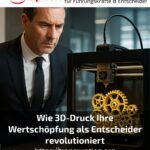
How 3D printing is revolutionising your value as a decision-maker
3D printing currently opens up diverse opportunities for companies looking to optimise their value creation. This technology not only offers a new form of production, but also enables decision-makers to rethink entire supply chains, thereby achieving flexibility, efficiency, and cost savings. Decision-makers who engage with 3D printing often experience how the traditional limitations of manufacturing are broken down.
More flexibility and agility in value creation
3D printing allows for significantly faster and more flexible product manufacturing. Instead of weeks or months, the production of many components now only takes hours. This allows production to be very well adapted to current demand. This agility in the production process ensures that companies can react more quickly to market changes. Furthermore, decentralised manufacturing via 3D printing significantly reduces transport routes, which speeds up the throughput of products and prevents bottlenecks.
In mechanical and plant engineering, for example, individual, complex components are often assembled from several milled parts. With 3D printing, these assemblies can be replaced by a single, optimised part. This saves assembly time and reduces sources of error.
BEST PRACTICE at company XYZ (name changed due to NDA contract) The company was able to produce individual components for special machinery in-house using 3D printing. This led to shorter delivery times and reduced warehousing, as spare parts can be manufactured on demand. This significantly improved operational efficiency without incurring the costs of expensive overseas manufacturing.
Cost savings through simplified supply chains
The use of 3D printing not only reduces production costs but also achieves hidden savings. Traditional supply chains with long transport routes and spare parts warehousing are expensive. 3D printing makes it possible to produce spare parts „on demand“ directly on site. This reduces inventory and drastically minimises transport costs – in some cases by up to 85 percent.
Furthermore, the workload is reduced because 3D printing can be intuitively controlled and machines operate largely autonomously. Companies thus gain greater independence from expensive foreign manufacturing.
BEST PRACTICE at ABC (name changed due to NDA contract) The company from the automotive sector manufactured spare parts for slow-movers using 3D printing directly in the warehouse. This significantly reduced warehousing costs. At the same time, customer satisfaction increased due to the faster availability of spare parts.
New Business Models and Competitive Advantages
3D printing is already enabling entirely new business models. Companies can cost-effectively produce individual small batches, thereby responding better to customer needs. Shorter product life cycles and rapid prototyping increase innovative capacity. This leads to products that are precisely tailored to the target audience.
As a consequence, competitive advantages arise from increased customer satisfaction and better service levels. The technology is increasingly perceived as consumer-friendly and even supports local employment through the reshoring of production processes.
BEST PRACTICE at DEF (name changed due to NDA contract) Toolmaking benefited from 3D printing as standard holders, previously made of steel, are now manufactured more easily and affordably using 3D technology. This significantly reduced unit costs and considerably shortened delivery times. This also opened up new customer segments for the company.
Integration and support during implementation
Decision-makers often face the challenge of how to efficiently integrate 3D printing into existing workflows. The technology is complex and requires a rethink of processes and production. Therefore, accompanying consulting and support services are helpful to provide impetus and facilitate adoption.
Many companies report that experienced guidance in a project environment significantly contributes to unlocking potential optimally. The challenge often lies in selecting suitable materials, choosing appropriate printers, and adapting designs for additive manufacturing.
My analysis
3D printing, as an innovation driver, is revolutionising value creation across many industries. Decision-makers benefit from greater flexibility, significantly lower supply chain costs, and the opportunity to develop new business models. It is important not to consider the use of this technology in isolation, but as an integral part of corporate strategy. With accompanying coaching and insights, the advantages can be better exploited and the introduction within the company can be shaped successfully.
Further links from the text above:
[1] 6 Underrated Benefits of 3D Printing for Your Supply Chain – Part 1
6 underrated benefits of 3D printing for your supply chain – Part 2
[3] 3D Printing in Business: Benefits, Integration and…
[4] Supply Chain 4.0: Revolution in Logistics through 3D Printing
[5] Study: 63% of German companies use 3D printing
For more information and if you have any questions, please contact Contact us or read more blog posts on the topic TRANSRUPTION here.






 Deutsch
  English (UK)