

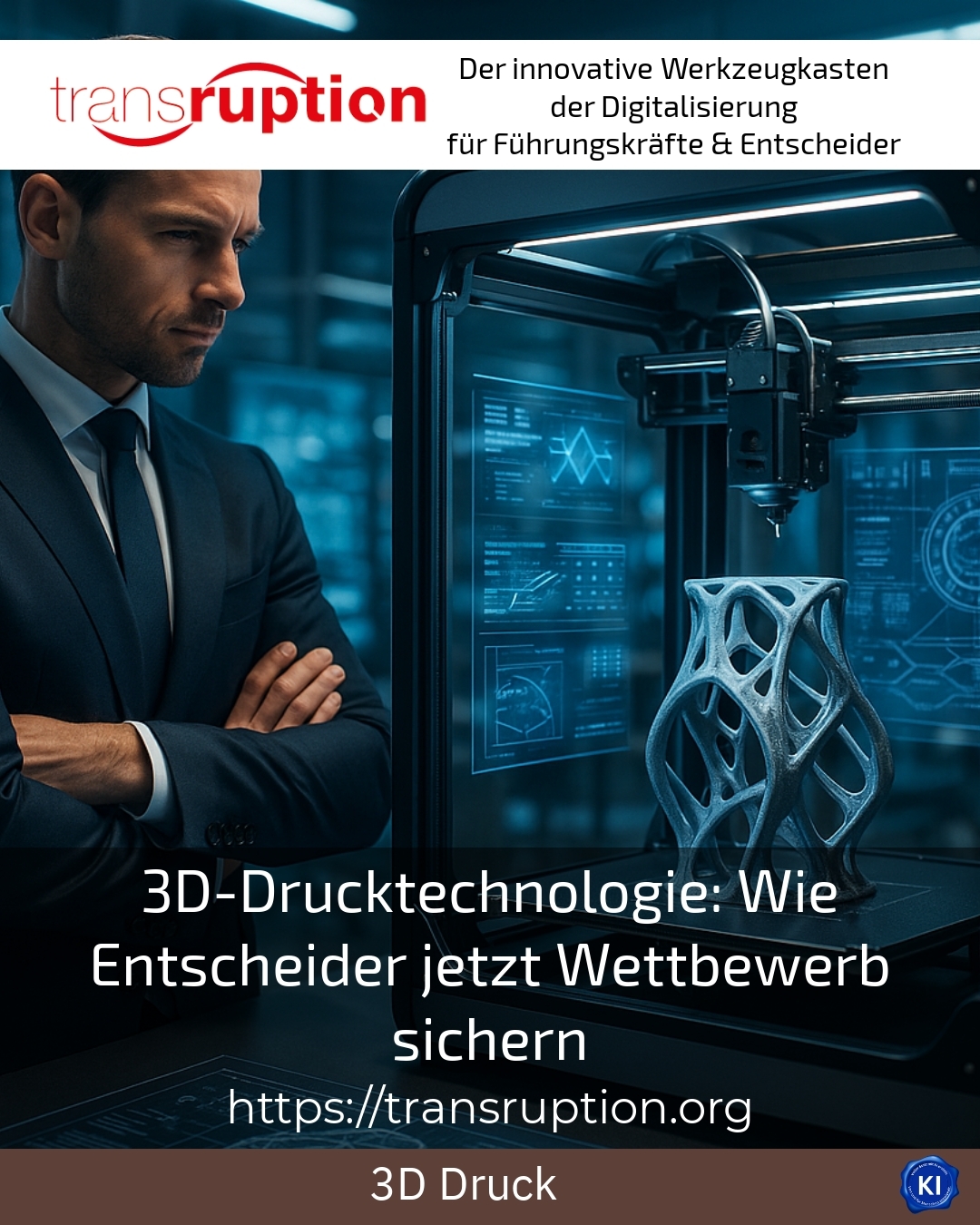
More and more companies are discovering the benefits that 3D printing technology can offer their business models. Executives and decision-makers, in particular, are faced with the question of how to actively shape the competition through digital innovations. The application possibilities today extend far beyond classic rapid prototyping and open up completely new opportunities in development, production, and logistics. Those who strategically use 3D printing technology can speed up processes, reduce costs, and respond individually to customer needs – thereby building a genuine competitive advantage.
Flexibility and Customisation as the Brand Core
Using 3D printing technology, products and components can be manufactured precisely to customer specifications, even in small runs or as individual pieces. This flexibility breaks down traditional manufacturing limitations and allows for specific requirements to be met directly. For example, medical technology companies that produce custom-fit prosthetics or implants benefit from high customer satisfaction and new business models [1]. In the consumer goods sector, too, for instance with jewellery or design objects, personalised solutions are becoming the norm. In the transport and logistics sector, spare parts are printed directly on-site, reducing storage costs and shortening delivery times. Even in skilled crafts, new revenue streams are emerging through limited editions or seasonal products.
3D Printing Technology in Practice – Examples from the Industry
The use cases for 3D printing technology are diverse. In the automotive industry, complex prototypes are manufactured within a few days, significantly shortening development cycles. Airbus uses additively manufactured components in aerospace, saving weight and material costs. In architectural model making, intricate detail models are created without laborious manual work. Sports goods manufacturers use the technology for lightweight, durable components that would be difficult to produce using conventional methods. The sports car manufacturer Ferrari, for example, uses 3D printing for wind tunnel tests and assembly components in Formula 1[7].
BEST PRACTICE at the customer (name hidden due to NDA contract) A medium-sized mechanical engineering company realised functional prototypes in just a few days using 3D printing technology. This allowed defects to be identified and rectified early on, while competitors were still waiting for traditional manufacturing steps. Time-to-market was reduced by several weeks, giving the company a significant advantage[1].
Small and medium-sized enterprises are using technology to produce small batches without expensive tools. This lowers fixed costs and makes small quantities economically attractive too [2]. On-demand manufacturing and customisation are thus becoming the norm in many industries. In the area of repair and maintenance, 3D printing technology also offers solutions for minimising downtime and making spare parts quickly available. Decision-makers who actively drive their digitalisation strategy benefit from increased flexibility, efficiency and innovation [6].
From idea to finished product – process optimisation with 3D printing technology
The path from the initial sketch to a market-ready product is significantly shortened by 3D printing technology. Prototypes are created in record time, and design changes can be made without significant additional costs. This allows companies to react more quickly to market changes and customer feedback. This is a decisive advantage, particularly for start-ups and SMEs, as it enables them to develop innovative products even with limited resources[2].
Additive manufacturing eliminates the need for complex tools such as injection moulds, particularly for smaller production runs. This opens up new design freedoms: complex geometries that would be difficult or very expensive to produce using conventional methods can be implemented without issue. This offers opportunities for lighter, more stable, or functionally optimised components – for instance, in the aerospace or mechanical engineering industries[5]. The range of available materials is constantly expanding, from plastics and metals to ceramics and composite materials.
BEST PRACTICE at the customer (name hidden due to NDA contract) A manufacturer of medical devices used 3D printing technology to produce patient-specific measuring instruments. Production became significantly more efficient because there were no expensive retooling times. This allowed delivery times and costs to be reduced while product quality increased.
Competitive advantage through 3D printing technology – strategy and implementation.
To fully exploit the potential of 3D printing technology, it is not enough to simply acquire a printer. Decision-makers should strategically integrate the technology into their value chain – from design to production to after-sales service. Companies with a clear roadmap report significant efficiency gains, cost reductions, and increased customer satisfaction[7]. The technology is particularly suitable for companies with small production volumes, complex products, and high demands on time-to-market.
The initial investments in hardware, software and expertise should not be underestimated, but the long-term benefits outweigh them. Companies that invest early secure sustainable competitive advantages and open up new business areas[6]. The integration of 3D printing technology is therefore less a question of technical skill, but rather a strategic decision for long-term market positioning.
BEST PRACTICE at the customer (name hidden due to NDA contract) A plastics processing company replaced traditional injection moulds with additive manufacturing for small batches. This enabled individual customer requirements to be met quickly and cost-effectively. The product range was expanded without the need for high investment in tooling. As a result, the company entered new markets.
Impetus for your journey into 3D printing technology
Many entrepreneurs and managers report that the introduction of 3D printing technology initially raises questions: Which technology is right for my business model? How do I deal with quality control and material selection? How do I integrate the new processes into existing structures? This is where transruptions-Coaching offers targeted support – from the initial idea to successful implementation within the company.
What is clear is that anyone embarking on the path of 3D printing technology today is investing in their company's future viability. The technology is an enabler for innovation, efficiency, and customisation. It allows products to be manufactured faster, cheaper and more precisely – thereby creating a sustainable competitive advantage.
My analysis
3D printing technology is no longer a niche phenomenon, but a central building block of modern manufacturing. It offers companies the chance to differentiate themselves from the competition through flexibility, efficiency, and customisation. Strategic use of this technology leads to shorter development times, lower production costs, and new business models. Integrating 3D printing technology into the value chain requires clear planning and targeted support – this is precisely where transruptions-Coaching comes in.
In a time when change and digital transformation bring new challenges daily, 3D printing technology is a real differentiator. Companies that invest now are laying the foundation for tomorrow's competitiveness.
Further links from the text above:
3D Printing Methods: Competitive Advantages for Decision Makers [1]
Advantages of 3D printing for small businesses [2]
Success strategy – 3D printing [3]
3D printing for small businesses: A competitive advantage [4]
voxeljet: 3D printer manufacturer for industry [5]
3D Printing in Small to Medium-Sized Enterprises: Efficient Production [6]
Competitive advantage thanks to 3D printing [7]
3D Printing: Prototypes, Spare Parts & Series Production [8]
3D printing service providers provide a competitive advantage [9]
New business areas and competitive advantages through 3D printers [10]
For more information and if you have any questions, please contact Contact us or read more blog posts on the topic TRANSRUPTION here.






 Deutsch
  English (UK)